I built EVM from scratch. Again.
TL;DR: yevm — (Yield-aware | Yet another) EVM implementation — async-first, WASM-native Ethereum VM in Rust, ~12.7K lines across 8 crates. 99.6% on GeneralStateTests at Cancun, cross-validated against revm on Osaka/Fusaka mainnet. Three application layers on top: in-browser simulation, yevm-lens for decoding execution side effects, and yevm-gate — a local RPC proxy that holds outgoing transactions until the human approves what they actually do. Try it live.
Last year I wrote about solenoid, the first EVM I built in Rust to understand the machine from the Yellow Paper up. That post was about the machine — opcode dispatch, gas accounting, the executor loop. This one is about what came after: an EVM rebuilt as a library you’d actually embed, and the three things I built on top to find out whether it’s useful.
The short version of the answer: yes, if you frame the EVM not as an execution engine but as an observability primitive. The interesting code is not the loop that runs opcodes. The interesting code is the loop that emits structured events as it runs them, and what you can do downstream with that stream.
Why a rewrite
Solenoid worked. It processed mainnet blocks, traced execution, ran in WASM. The issues were structural, not bugs:
- The state interface was synchronous-ish, async only by accident.
- The trace stream was a debug feature bolted on, not the primary output.
- The crate layout couldn’t be sliced — you took all of it or none of it.
yevm is the second pass with those three things at the center. The crate split:
yevm-base   primitive types (Acc, Int, Tx, Head, Buf)
yevm-core   the EVM engine — executor, ops, precompiles, state traits, trace
yevm-misc   utilities, keccak, hex
yevm-test   harness + GeneralStateTests + revm cross-validator
yevm-lens   side-effect decoder over trace events
yevm-gate   pre-broadcast RPC proxy with sim + human-in-the-loop approval
yevm-wasm   browser bindings
yevm        top-level integration
The first three crates (base, core, misc) are what you embed; the last four (test, lens, gate, wasm) are applications of the EVM, built on top of the same trace stream. None of the application crates know about each other.
Async-first, not async-on-top
Every external state access in the EVM is a potential network round-trip: SLOAD, BALANCE, EXTCODESIZE, EXTCODEHASH, EXTCODECOPY, and the implicit account-load on CALL/STATICCALL/DELEGATECALL. In a synchronous EVM you have to pre-fetch state or block the executor thread. Both options are bad: pre-fetching requires you to predict the access set (which the EVM itself decides), and blocking ruins composition.
In yevm the executor is async end-to-end, and chain access lives behind a small async trait:
#[cfg_attr(not(target_arch = "wasm32"), async_trait::async_trait)]
#[cfg_attr(target_arch = "wasm32", async_trait::async_trait(?Send))]
pub trait Chain {
    async fn nonce(&self, acc: &Acc) -> eyre::Result<u64>;
    async fn balance(&self, acc: &Acc) -> eyre::Result<Int>;
    async fn get(&self, acc: &Acc, key: &Int) -> eyre::Result<Int>;
    async fn code(&self, acc: &Acc) -> eyre::Result<(Buf, Int)>;
    // ...
}
Implementations: an Rpc that hits a JSON-RPC endpoint, a Cache that wraps Rpc and remembers fetched state. The executor doesn’t care which.
The yield-points are real. Running a single mainnet transaction with a cold cache produces dozens of eth_getProof / eth_call round-trips, interleaved with pure computation. Async/await composes that naturally with no callback gymnastics, and — the point that ends up mattering most — the same executor code runs unchanged inside a browser, with the network calls served by fetch() and the futures driven by the browser event loop.
Trace events as a first-class output
The trace stream is the primary output of execution, not a debug toggle. Every meaningful operation emits a typed event:
pub enum Event {
    WarmKey(Acc, Int),
    WarmAcc(Acc),
    Move(Acc, Acc, Int),
    Get(Target),
    Put(Target, Int),
    Hash(Buf, Int),
    Code(Buf, Int),
    Log(Vec<Int>, Buf),
    Call(Call, CallMode),
    Return(Buf, u64),
    Revert(Buf, u64),
    Halt(HaltReason, u64),
    Undo(usize, usize),   // seq range [from, to) reverted
    Create(Acc),
    Delete(Acc),
    Fee(Acc, Acc, Int, Int, u64),
    Blob(u64, Int),
    Step(Step),
}
Two design choices in here that I keep getting mileage out of:
Revert handling is out-of-band. Events stream out as they happen, including from sub-calls that later revert. When a revert occurs, the executor emits Undo(from, to) — a sequence range that downstream consumers re-mark as reverted = true. The alternative (buffer everything, commit on success) needs unbounded memory and breaks streaming. The chosen alternative lets every consumer choose: ignore reverted events, include them as warnings, or whatever they like. yevm-lens ignores them; a debugger would render them differently.
Hash preimages are observable. Every KECCAK256 emits Hash(input, output). That single event is what makes ERC-20 balance-slot detection possible downstream: when you later see a storage write to slot 0xabc..., you can look up the preimage and discover “this was keccak256(holder, mapping_slot) — it’s a balance write for holder X”. No heuristics, no scanning bytecode. The executor already did the hash; just keep the input.
Application 1: WASM in the browser
yevm-core builds for wasm32-unknown-unknown without modification because there is nothing platform-specific in it — no threads, no filesystem, no sync I/O. yevm-wasm is a thin layer of wasm-bindgen glue that exposes the executor to JS, with fetch() standing in for the RPC client.
The full pipeline in the browser:
- User pastes a tx hash or raw signed tx into the demo UI.
- JS calls into the WASM module’s
simulate(tx, head). - The executor runs, yielding on every state access; each yield becomes a
fetch()to the configured RPC. - Trace events stream back out as a
Vec<Trace>. yevm_lens::analyse(&traces)decodes them into a flatAlertsstruct.- UI renders the decoded side effects.
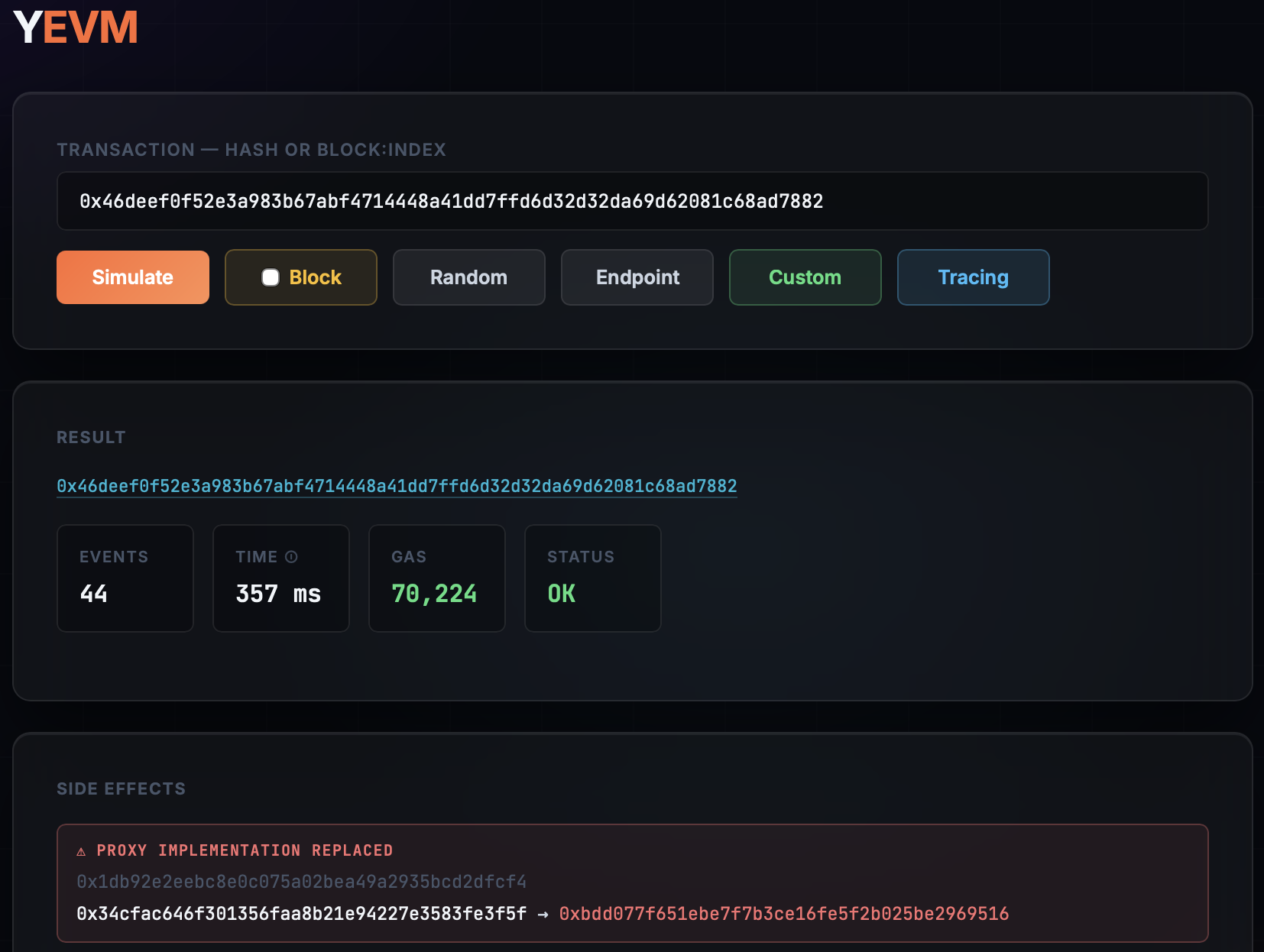
The only privacy boundary is the RPC node — it sees eth_getProof / eth_call queries for the state slots the simulation touches. No one sees the transaction, the signer, the dApp context, or the verdict. Compare to the operational shape of Blockaid / Wallet Guard / Harpie / Hypernative, which ship your candidate transaction to a remote API for scoring. Running the EVM locally in WASM is the only architecture where that guarantee holds by construction, not by trust.
Application 2: yevm-lens — decoding side effects
The lens crate turns a trace into the answer to the only question a human is really asking before signing: what is this transaction going to do?
pub struct Alerts {
    pub proxy_swaps: Vec<ProxySwap>,
    pub eth_changes: Vec<EthChange>,
    pub erc20_transfers: Vec<Erc20Transfer>,
    pub erc20_approvals: Vec<Erc20Approval>,
    pub erc721_transfers: Vec<Erc721Transfer>,
    pub forged_transfers: Vec<ForgedTransfer>,
    pub fee: Option<FeeInfo>,
}
The two detections I’m most happy with:
Proxy implementation swap. The Bybit hack swapped a Safe’s implementation to an attacker contract via DELEGATECALL. The signers approved the inputs; nobody had the side effects. Lens fires ProxySwap when a storage slot whose value looked like an address gets overwritten with a different address-like value, and the old implementation was called or loaded earlier in the same transaction. The second filter is what keeps it quiet — real upgrades route through the old impl first, plain state writes don’t.
Forged transfers. Phishing tokens emit Transfer logs without ever moving balance, then drainers wait for the approval that follows. Lens cross-references every Transfer log against the actual balance storage writes (using the hash-preimage trick above) and flags log/state mismatches as ForgedTransfer. The wallet UI can render the two very differently.
The full crate is one file: yevm-lens/src/analyse.rs.
Application 3: yevm-gate — pre-broadcast hold
yevm-gate is the productized version of the principle. It’s a local HTTP server that speaks JSON-RPC, designed to sit between your wallet and your upstream node:
wallet ──▶ yevm-gate ──▶ owner (pending approval)
               │
               └── decode · simulate · analyse · hold

owner ──approve ──▶ upstream RPC
owner ──reject ──▶  (drop)
The wallet thinks the transaction was sent. The transaction is not sent. It sits in pending state until the owner authenticates and explicitly approves or rejects:
async fn intercept_send_raw(state: Shared, body: Value) -> Result<Json<Value>, AppError> {
    let raw = /* extract params[0] */;
    let decoded = decode::decode_raw(&raw)?;
    let hash = format!("{}", decoded.tx.hash);

    db::insert(&state.pool, &hash, &decoded.call.by, &raw, &sim_init).await?;
    state.pending.write().await.insert(hash.clone(), PendingTx { /* ... */ });
    spawn_sim(state, hash.clone(), decoded.call, decoded.tx);

    Ok(Json(json!({ "jsonrpc": "2.0", "id": id, "result": hash })))
}
Auth is SIWE-style: server issues a nonce, owner signs it with the same key that signed the transaction, server hands back a bearer token. Only the signing address (or a configured admin) can see and act on a pending tx. Approve forwards the raw transaction to the upstream node; reject drops it.
This shape — the wallet doesn’t know the difference, the gate runs locally, the owner is the only party that can release the tx — is the thing I keep coming back to. It doesn’t require wallet integration, hardware-wallet vendor cooperation, or anything cooperating. You point your wallet’s RPC at localhost:8000 and you’ve inserted a human-in-the-loop step that the entire stack downstream cannot bypass.
Correctness
Two weeks from a blank editor to 99.6% Cancun coverage. Two more months to close Osaka/Fusaka and hunt down the edge cases — transient storage, EIP-7702 delegation chains, the kinds of contracts that only appear on mainnet and never in test suites.
Two ways the EVM is validated:
GeneralStateTests at Cancun. The Ethereum Foundation’s tests repo covers every opcode, every gas edge case, every pre-compile, across every hard-fork. Yevm passes 99.6% of the Cancun set; the missing tests are mostly EIPs I have deferred (the test harness in yevm-test skips them by name).
Cross-validation against revm. yevm-test/src/revm.rs wraps revm in an Inspector that produces the same Step events yevm emits, runs both implementations on the same transaction, and diffs the traces. This catches divergences the official tests don’t reach: real mainnet contracts doing unusual things with EXTCODECOPY, MCOPY, transient storage, EIP-7702 delegations. (The official test suite targets Cancun; revm cross-validation extends coverage forward to Osaka/Fusaka, where no official test suite yet exists.) Convergence with revm is the practical correctness story, since revm is the de facto reference for production EVMs in Rust.
Performance
373 mainnet transactions from a randomly chosen mainnet block, offline prefetched state, 1000 iterations: 77ms per block — well under the 12-second block time. Starting point was 360ms; the gap closed through generic dispatch to eliminate vtable overhead, stack-allocated warmup buffers, direct PUSH slice reads, and gating trace-only allocations behind is_tracing().
What’s next
-
Per-signer touched-set baseline. Bybit landed on an implementation address none of the signers had ever interacted with before. A per-signer baseline of every address touched at any call depth, in the signer’s history, catches a novel
DELEGATECALLtarget with one extra check on top of what lens already does. The set stays small enough to ship client-side as a bloom filter. -
Opcode-weighted severity in lens. Every alert is presented flat today; in practice a novel
DELEGATECALLtarget should scream and a novelSTATICCALLshould whisper. The infrastructure is there; the policy isn’t written yet. -
Make yevm-gate into a service. Running it locally is a one-command setup, but the same gate can run on a server — approvals authenticated by the owner’s wallet signature, transactions held until released. Not an architectural change; just deployment.
-
Glamsterdam readiness. EIP-7782 proposes halving the slot time to 6 seconds. At 77ms per block yevm is already comfortable at 12s; the margin at 6s is thinner, and the gate’s human-approval window shrinks proportionally. The plan: profile the hot path under 6-second timing, validate the new EIPs in the test harness, and make sure gate’s UX doesn’t become a footgun when blocks arrive twice as fast.
Running it
git clone https://github.com/sergey-melnychuk/yevm
cd yevm
cargo test --workspace
To run the gate as a local RPC proxy:
export YEVM_RPC_URL="https://your-upstream-node/..."
export YEVM_PROXY_BIND="127.0.0.1:8000"
cargo run -p yevm-gate
# point your wallet's RPC at http://localhost:8000
# open http://localhost:8000 in a browser to authenticate and approve/reject
To build the WASM bundle:
cd yevm-wasm
wasm-pack build --target web --release
python3 -m http.server 8000
# open http://localhost:8000/demo.html
Or just open the live demo.
Disclaimer. yevm is a research project, not an audited production system. The EVM is correct enough to validate against mainnet; the application layers (lens, gate) are correct enough to be useful but not enough to be load-bearing for real money without further hardening. The lens decoders are pattern-based and a determined attacker who knows the patterns can shape execution to slip past one of them. Use it to learn, to instrument, to prototype — not to gate a treasury.
Full code: github.com/sergey-melnychuk/yevm. Talk slides: sergey-melnychuk.github.io/yevm/deck. Prior post on the EVM itself: Ethereum VM impl from scratch in Rust.